Showing posts with label Rosslyn Chapel. Show all posts

Monday, 10 June 2013

Brown's Inferno and a Theoretical Analysis of the San Giovanni Baptistery


In my last post, I made a brief analysis of Rosslyn Chapel and contemplated the storyline of Dan Brown’s Da Vinci Code.  After the recent release of Inferno, I would like to follow up with a post on the San Giovanni Baptistery (SGB) in Florence. I was very fortunate during my MSc to take a Renaissance course with Dr. Jill Burke where we spent eight days in Florence visiting art historical sites and partaking in seminars in nearby Prado. While there I made several visits to SGB, thus increasing my liking of Brown’s use of the building in his novel. Taking cue from Samuel’s last post on perceptions, I would like to discuss in this post how Brown perceives the imagery of SGB, and follow with my own thoughts on the building. Brown has used SGB as a stage for his Dante theme, but I believe there is more to be told in the numerological qualities of the structure than Brown reveals in his publication.


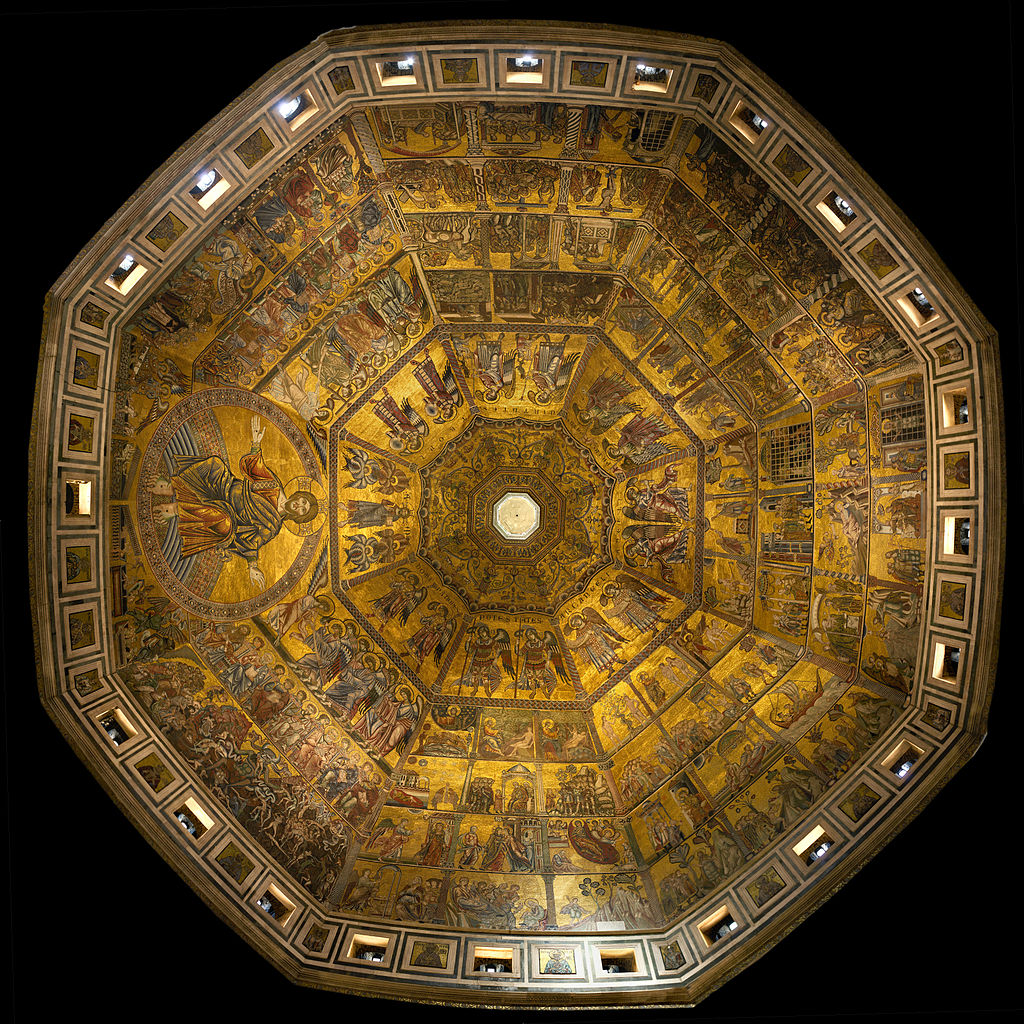
Brown uses the imagery of the SGB and the neighboring Duomo in his story to emphasize Dante’s Purgatorio, the nine-layered mountain of suffering and spiritual growth before reaching Eden.  As Robert Langdon & Sienna (his new female companion) enter SGB, Robert looks to the glittering ceiling and notes the “multitiered representation of heaven & hell, very much like the depiction in The Divine Comedy.”[1] Similar perhaps, but not a true likeness. SGB was in fact the location of Dante’s baptism, and as a native of Florence, he likely frequented the building in the process of writing. I agree that Dante was potentially inspired by the tesserae ceiling of SGB, but Dante’s Purgatorio consists of nine levels, where the mosaics of SGB are set in six or seven registers(depending on if you count the “oculi” as a layer, on right). The nine-tiered “cosmic mountain” is a creation of Dante’s and was not featured in art until after the release of his publication. The mosaics depict the life of Mary, Joseph and Christ, including The Last Judgement. The three-headed Satan in this scene is also similar to Dante’s, perhaps serving as further evidence as inspiration for the publication. I consider the inclusion of a known Dante site successful, but it should be noted that the ceiling is NOT a representation of Dante’s Purgatory, but an influence for his written work.
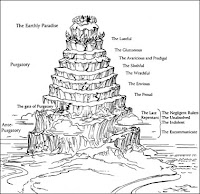

Dante's Nine-Layered Purgatory
Satan in the SGB mosaic


7-registers of SGB mosaic, Octagonal frame

Although the mosaics are the true treasure of this structure and a fine tie into Brown’s novel, I can’t help but note the geometrical and numerological features of the structure over the tesserae. Nine may be the magical number of Dante, but it is not the number to be searching for at SGB. The first feature to be noted is that the building, including the roof which supports the mosaic, is octagonal. Eight is a reference to God’s infinite power as the figure 8 is infinity when turned on its side. Eight is also commonly seen in Christian art in reference to God’s creation of heaven and earth on the Sabbath, followed by the eighth day in which Christians were reborn through baptism. Also to be considered is the flooding of the world where Noah rescued eight people on his Ark, an event considered a “mass baptism.” This would have been ideal reference for Brown to have made as his “villain” attacks by means of water to cleanse what he considers to be an overpopulated earth. Brown may not have taken advantage of SGB's symbolic numbers, but Dante, "who [was] versed in geometric lore,"  likely admired the features I have noticed. [2]

Seven is also a number of interest. As mentioned earlier, the ceiling is made of seven registers depicting the life of Mary, Joseph, and Christ. Seven is significant in Dante’s Purgatory as he uses the Seven Deadly Sins to make up the first seven layers of his cosmic mountain, but in the case of SGB, the number seven is not likely related to the Seven Deadly Sins. I find it more likely that the use of seven registers in the mosaic refers to the Seven Virtues, the Seven Gifts of the Holy Spirit, the Menorah (which is seven-lamped), or perhaps Peter asking Jesus to forgive those who have sinned against him seven times. There is no evidence to prove one idea over another, but I am partial to the reference to the Menorah. The Menorah symbolizes universal enlightenment. The seven candle holders represent the branches of human knowledge. I prefer this reference because of the lantern that tops the baptistery. The emission of light atop the octagon potentially represents the eternal light of God. This is of course all theoretical, but the potential symbolism is intriguing and poetic; the seven branches of knowledge are lit eternally by the power of Christ.
Exterior of SGB

Although Brown has made a nice link between SGB and Dante for the sake of his novel, there is much to be uncovered in the images and format of the building. My suggestions in this post just scratch the surface of potential meanings within layout and art of this building. Brown has thus proven that the structure has served as inspiration and been interpreted by many individuals for centuries, including Dante, including Brown, and now myself.


~Emily

[1] Brown, Dan. Inferno: A Novel. New York: Doubleday, 2013. 239. Print.
[2] "Paradise. Canto XXXIII. Dante Alighieri. 1909-14. The Divine Comedy. The Harvard Classics." Paradise. Canto XXXIII. Dante Alighieri. 1909-14. The Divine Comedy. The Harvard Classics. Bartleby Online Books, n.d. Web. 10 June 2013.

Monday, 13 May 2013

Fact, Fiction, & Theory: An Analysis of the Ceiling at Rosslyn Chapel


It is time that Beyond Borders discusses one of the more controversial subjects in academia and popular culture: Dan Brown’s Da Vinci Code. Since the book's release in 2003, the internet has been booming with those debating the facts in Brown's novel. I have to admit that I am a HUGE Dan Brown fan and have been scanning through ten years of articles and blogs on the book. I have read theories involving everything from sacred geometric music theory hidden within decor, to the fact that Rosslyn Chapel is a space ship  that is bound to launch into space upon the second coming of Christ (I kid you not!). As the end of my school year approaches, I feel the need to step away from the traditional academics I've been teaching and write a post questioning the facts and fantastical fiction of this novel. 


Dan Brown states in the cover flap of his book that his work is a blending of fiction and historical fact. This is the subject I wish to discuss today—fact, fiction, and theory.  I had the pleasure of visiting Rosslyn Chapel while residing in Edinburgh and it was here that I first began investigating Brown’s story-line on a more academic level. In this post, I will briefly discuss Brown’s plot points, and follow with a theoretical investigation of the Rosslyn Chapel ceiling. This study has allowed for an exploration into a fictional story that I have enjoyed for many years, but has also led me to question how much of this story fact and how much is fiction. 


My research began with a small publication on the chapel by the Earl of Rosslyn, a successor of the St. Clair family. This is the same St. Clair family Brown named as the descendants of Christ in his book. This theory has yet to be proven, but the St. Clair family does have ancestral connections to the Templar Knights. One aspect of  Brown’s theoretical fiction is thus revealed: The St. Clair’s are descendants of Christ, and later had family members that joined the Templar Knights, or perhaps the more ‘shadowy’ sector of the Templars, the Prieuré de Sion (Priory of Sion), who Brown suggests protect the treasure of Christ—his bloodline, which was continued through a child produced by Jesus and Mary Magdalene. In reality, the Prieuré sought the great Roman treasure hidden at Solomon’s Temple. Although a wonderful aspect of the story, the only factual piece of information is the family’s Templar lineage. There is no evidence of the St. Clair Templar Knights being members of the Prieuré, or that they knew of a secret bloodline of Christ. The Templars were, for those of you unfamiliar with their history, nine French knights that were asked by Baldwin II of Jerusalem to protect Christian pilgrims travelling in the Holy Land. Their numbers grew greatly until the early fourteenth century when the group was persecuted for crimes of heresy. According to the Earl of Rosslyn’s historical recollection, “lodgings were provided on the site of the former stables of King Solomon, beside the site of the ruined temple.” As discussed in a previous post, Dome of the Rock is often thought to be the sight of the former Temple of Solomon and was also a home to the Romans. This fact is significant as it was thought that the Prieuré de Sion’s aim was not to protect, but to find the lost treasure that the Roman emperor Titus left hidden at the sight. The conflicting factor in this is that Dome of the Rock is a seventh century creation. Perhaps the ruins of Solomon’s Temple were still present on the esplanade during the Templar occupancy, but since we cannot prove this, the Solomon and Templar manifestation on the esplanade is questionable. The site of Solomon's Temple is equally as questionable as the treasure that was hidden there. As suggested by Brown and others, the supposed treasure was brought by Sir William de St. Clair, a Knight Templar, back to his home from the East. William is said to have built Rosslyn as a safe-house for his treasure. Many have suggested that the great Templar treasure is buried in the basement of Rosslyn, but that has not been confirmed as no one, including the St. Clair family, has entered the underground compartment in years.

Being that this tale leaves the world with many "maybes" and "what ifs," the best I can do is contribute to the architectural analysis of Rosslyn Chapel and hope that my suggestions are taken a little more seriously than the "space ship theory" previously mentioned. What I would like to propose today is that the Rosslyn Chapel ceiling is a series symbols in reference to the sacred feminine, and ultimately the Virgin Mary, the figure to whom the chapel is dedicated.


The ceiling is a numerologist’s dream. The features are more symbolic of the Virgin Mary verses Brown’s featured Mary Magdalene, but a reference to a female, or a “sacred feminine,” still follows Brown’s storyline. The ceiling is divided into five sections featuring a variety of floral and star patterns from east to west. The patterns are set as follows:


1.      Four-Petalled flowers

2.      Multi-lobed leaves with four-petalled flowers

3.      Double roses

4.      Lilies

5.      Stars


The division of the ceiling into five sections may be a reference to the star shape in section five, a common symbol of Venus or the sacred feminine. Among the stars of the fifth section are angels, the moon, the sun, a dove, and in the bottom right hand corner, the face of Christ raising his hand in blessing. Christ’s blessing may be over the viewer below, or perhaps he is blessing the intermingling of male and female, which are represented as the sun and the moon.The image of Christ among the stars may also refer to five wounds of Christ, represented in each point of the star. 

The foliage of the four remaining sections are Christian symbols of the Virgin and other sacred female characters. The lily is a symbol of chastity and is often seen in the hands of either the angel Gabriel or the Virgin in Annunciation scenes. The rose is open to several interpretations. The rose has been a significant symbol since the Ancient Egyptian goddess Isis, the mother of Horus. Isis has often been linked to rose imagery and also shares the planet and floral symbol with the Greek goddess Venus. In the Middle Ages, the Virgin Mary was known as Santa Maria della Rosa. Being that Mary was a rose, Christ was her heir and also a rose, hence the idea of a “rose line” and Brown’s connection to “Roslin,” the name of the town, or “Rosslyn,” the more common spelling for the chapel. Brown also uses the ancient “sub rosa” in his novel, a reference to the Romans who hung wild roses on the doors where confidential conferences took place. The borrowing of this term and the idea of the rose as a symbol for Mary allowed for the creation of the secret of the bloodline lying “under the rose.” Others have suggested that the remaining flowers are perhaps daisies, sunflowers, or marigolds. Daisies were a preferred symbol for Christ’s purity in the late Middle Ages (after the completion of the chapel) versus the regal fleur de lis. Sunflowers were a reference to “the son of God,” though I believe this assumption to be less tangible as the sunflower is not native to the British Isles. I do, however, like the marigold reference as it is a continuation of the sacred feminine and Virgin Mary theme. Marigolds are thought to derive from the term “Mary’s gold,” a reference to the gifts Mary gave to the poor who did not have actual gold. The identification of these flowers is theoretical, but I find the marigold the more applicable of the suggestions being that the chapel is dedicated to the Virgin.

What I can conclude from this study is that Dan Brown did his homework. His thorough knowledge of history, art, religion, and symbolism allowed for his creation of a semi-believable plot line. How far the facts within the novel go will be deliberated with further study, but for now, I recommend you simply enjoy the book for what it is—a blending of history and fantastical fiction.

~Emily