Monday, 24 September 2012

The Artuqid Plate


Part of our purpose here at Beyond Borders is not only to share our own scholarly insights, but also to perpetuate an academic discourse about art during the global Middle Ages via our posts.  So, with this in mind, my contribution this month will focus upon an object that is multivalent, and through its layered complexity, allows many queries to be raised about its intended purpose and meaning. It is my hope that you (our readers) will comment upon the considerations I propose and formulate additional questions and/or suggestions about this interesting object.

Within my studies of Islamic artefacts, at times I have fortuitously discovered an object that, due to the contents of its textual and visual programme, questions the cultural origins to which it has been assigned. The twelfth century Artuqid Plate is such an object. The Artuqid Plate, also known as the Innsbruck Plate (the latter attribution is based upon the fact that it is part of the collection of the Tiroler Landesmuseum Ferdinandeum, Innsbruck, Austria), contains illustrations that are reminiscent of both Islam and Byzantium. The artistic programme of this plate is universal enough to be seen in both Christian and Islamic regions, which may be interpreted as a clear example of cultural translation. However, this cultural translation, in turn, places this object in the conundrum of being either both Islamic and Christian or neither.

Overall the Innsbruck Plate is enameled with gilded metal. It is important to note that enamel work was not part of the repertoire of Islamic craftsmanship, but instead was more reflective of Byzantine artisanship. Both the interior and the exterior of the plate have been decorated in a similar style and the handles are a later European addition. According to Scott Redford, the plate was most likely produced in Georgia, which was periodically located in or on the fringe of Islamic empires. Per Scott Redford, the probable production of the plate in Georgia explains the use of enamel since the art created within this area was generally derived from Byzantine prototypes. The Innsbruck Plate has many illustrative features, but this post will focus upon the roundels and inscriptions on the front side of the plate. The other aspects of the plate are also significant, but will not be addressed in an effort to keep this post succinct.

The front of the plate is comprised of three sections, which will be discussed individually. The first section may be defined as the central roundel, which depicts the apotheosis of Alexander (Alexander’s glorification to a divine level). The second section is composed of the six roundels that surround the central circle and illustrate fighting scenes and frontally depicted birds. The third section is the outermost area (the lip of the plate) and is composed of inscriptions, which contain the names, titles and genealogical information of an Artuqid ruler.

Within the first section (centremost roundel) Alexander is holding two sceptres that more or less form an X or Chi. The tips of the sceptres are adorned with forms that are reminiscent of either fish or flowers, both of which embody Christian symbolism. Alexander is also flanked by what has been identified by scholars as two griffins. The griffin is a mystical creature whose varied symbolic meanings date back to antiquity. The griffin was thought to be an especially powerful and majestic creature, which was used to guard precious possessions and safeguard against evil and witchcraft. An example of the griffin’s symbolism may be seen in Christendom where the duality of the griffin (its amalgamation of lion and eagle) was considered to be representation of the human and divine natures of Jesus. There are many more attributes associated with the griffin, and it may be suggested that the use of such a symbolically powerful and multivalent creature within the visual programme of the Innsbruck Plate, not only speaks of the authority of Alexander, but also of the overall symbolism of the plate.

The next section is composed of six roundels that surround the central circle. These roundels depict front facing animals and animals in combat, which may represent political prowess (associated with either Christianity or Islam), a religious meaning, or both. On one hand, it may be interpreted that the frontally illustrated birds are eagles, the evangelist symbol of John. The depictions of a halo above the eagle’s head and of the eagle grasping a snake should be noted because it may refer to evangelist imagery. On the other hand, these birds or eagles may not refer to the Evangelist John, but instead were depicted to portray an association with the tree of life, which may be the symbolic meaning associated with the illustrated trees that serve as part of the surrounding background. Other figures such as dancers and acrobats are also part of the background imagery.

The third section of the plate is the outer rim, which is composed of two lines of script, Arabic (interior) and Persian (exterior). The inscriptions are a list of titles, epithets, and names associated with the genealogy of the Artuqid rulers. Redford notes that the inscription is of poor quality and is also confusing because the manner in which the names are inscribed does not make genealogical sense. Additionally, according to Redford, the text seems to be written in a script that is described as handwritten Naskh, but is generally difficult to assign a cursive style to due to its general illegibility.

            The Innsbruck Plate holds many symbolic meanings, many of which could not be fully explored in this contribution. However, I hope this brief introduction to the plate will spark further inquiry.  Here are some of my considerations I would like to share:

*The number of roundels should be explored in relation to Christian and Islamic religious ideologies, astrology and cosmology.

*What is the significance of the images within the roundels in comparison to the background of the decorative programme?

*The Innsbruck Plate falls within a gray area of cultural origin. Should these items be considered a product of the socio-cultural inhabitants of the region instead of their religious affiliations? At this point, the recognition of cultural translation will be a necessary aspect of evaluation instead of an optional inquiry.

~Shandra

______________________________________________________________________
Redford,Scott. ‘How Islamic Is It? The Innsbruck Plate and Its Setting,’ Muqarnas, 7 (1990), 119-13.

Grabar, Oleg. ‘The Crusades and the Development of Islamic Art,’ in The Crusades from the Perspective of Byzantium and the Muslim World, Dumbarton Oaks, (2001), 235-245.


Monday, 17 September 2012

Minarets


As some of you may know, I have recently started teaching High School AP Art History in my home state of South Carolina. It’s been a rough month of adjustments, but I have come to love my students and their enthusiasm and am enjoying teaching the next generation of academics.  This week we spent some time looking at Byzantine and Islamic art, some of my favourite. The art of the East is unfamiliar to the majority of my students, having only been exposed to some of the more recognized Western works of art like the Da Vinci’s Mona Lisa and Monet’s Water-Lily Pond.  My high school seniors were fascinated with the geometric patterns and ornate architectural creations of the East, thus inspiring my post for this week: the minaret.The minaret, unlike the mihrab and minbar of the mosque, has not been subject to the same in-depth study when discussing symbolic significance in Islam. It is the location where the muezzin calls the faithful to prayer and has become a necessity in mosque design, especially as populations increased. Older mosques are accompanied by one or two minarets, whereas later mosques, or mosques in more progressive cities, have multiple. The need for several minarets at heavily populated locations, like Mecca, is so the call can be heard in all directions of the city. The original Muslim place of worship, the house of Muhammad, had no such structure and the daily calls to prayer were made from the roof of the house. Minarets are not noted until eighty years after the death of the Prophet and are perhaps an adaptation of Christian bell towers.  The similarities between minarets and bell towers involves height, duality as a guard tower, and as a location to announce church services and calls to prayer. However, light is a significantly more important feature in minarets and is exemplified in the word’s etymology.

            The religious purpose of the minaret is to announce the five daily prayers, but the name ‘minaret’ is what connects us to the topic of sacred light. The origins of ‘minaret’, manārah, means ‘lighthouse,’ and has the inclusion of the word nār, meaning ‘fire.’1 Arabic poems make reference to the light of a monk’s cell as he transcribes the word of God, and this is perhaps how the word came into being.2 In turn, a lantern is often placed in the mihrab as representation of the ‘light’ of Allah.3 The Koran references this sacred light in 24:35.

This same idea is applied to the minaret for the evening prayer. The muezzin climbs to the top of the minaret and makes the call to prayer, his path lit by a small lantern that flickers out to the faithful who prepare for the fifth paying of homage. The etymology of the word certainly implies religious significance to the light of Allah shining out into the darkness for prayer. Again, the idea of sacredness and light is more often linked to the lighting of the mihrab, but the action of lighting the way to the mosque is certainly intentional and symbolic and it is important that the minaret is recognized alongside its architectural counterparts.
           
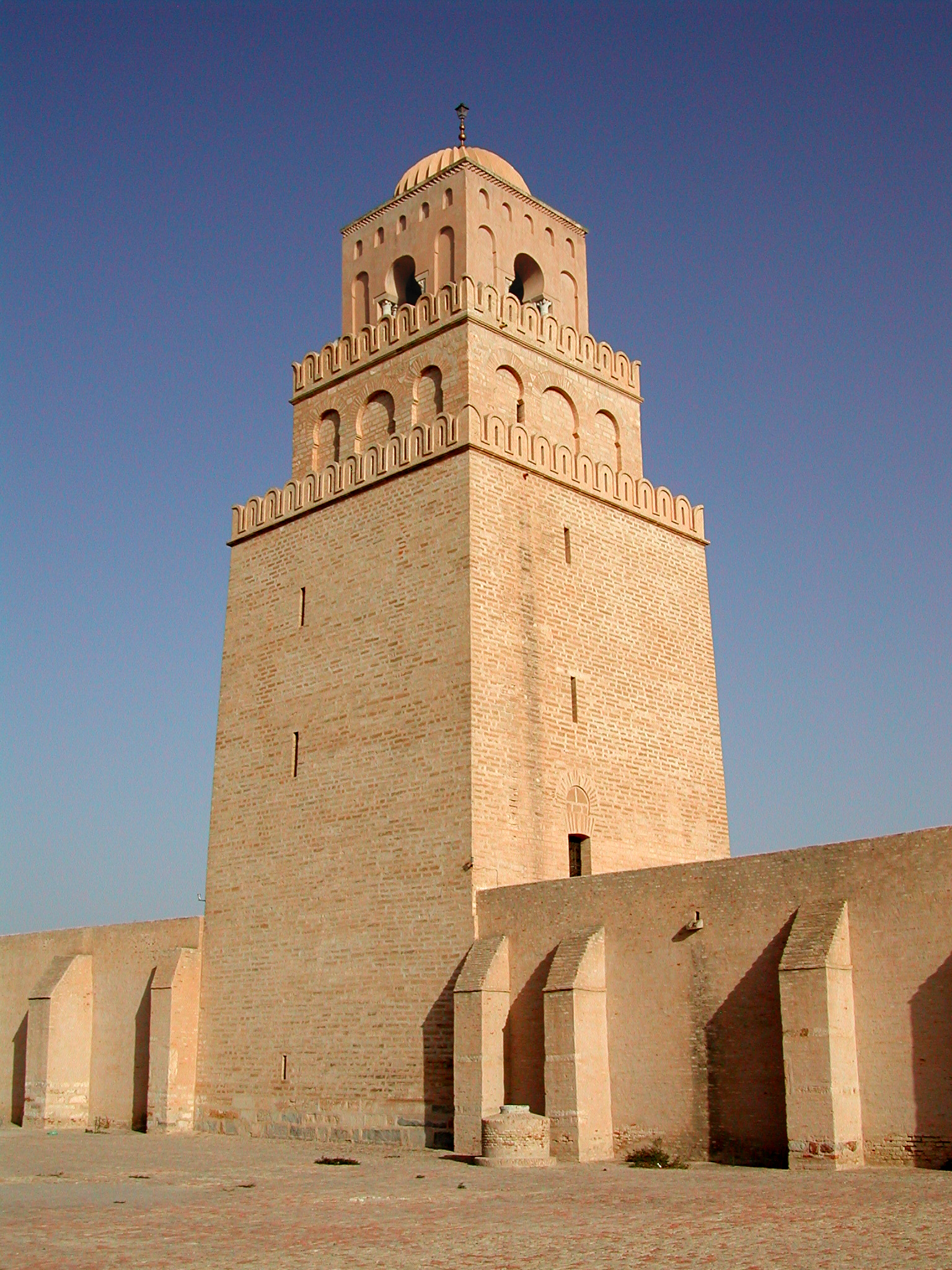
As mentioned, minarets are relatable to Christian bell towers. The sacredness of light is more prominent in minarets, but the dual functions of both towers and minarets make them great subjects of comparability. Having a location of great height is important in both Christian cities of the West and Islamic cities of the East for means of protection. Guard towers were likely to exist in Muslim cities and it was possible that doubling the guard tower as a place for call to prayer followed the design of Christians residing in the East. One example of a minaret with a potential history of acting as a guard tower is the minaret of the Great Mosque of Kairouan (above).The minaret of Kairouan is the oldest surviving minaret in the Maghreb region (Northwest Africa) and dates to either the reign of Umayyad caliph Hicham Ibn ‘Abd al-Malik (724-743) or Ziyadat Allah I (817-838), to whom the mosque is attributed to.4 The facade facing the interior of the structure features square windows with bricked lunettes on a three-tiered building,while the outer facing walls are dotted with small slits serving as holes for defensive weaponry.5 This confirms the minaret’s militaristic use.     

The third floor was remodelled in the thirteenth century, complete with a large lantern. It should be noted that in some Islamic sanctuaries, Christian bells were taken as a means of spolia and repurposed as chandeliers.6 This is symbolic of the rise of Islam overpowering the existence of Christianity and the light of Allah out-shining Christian practices.  The sacred light of Allah and the call to prayer create a theological interpretation of the minaret as an architectural feature. Although it could not be said if the religious functions out-shine the more militaristic use of towers, the domineering message of Islam over Christianity, and the protection the tower provides against invaders creates a sense of cultural strength in this architectural feature.

~Emily


[1] "Definition of Minaret." Dictionary.com. Accessed March 05, 2012. http://dictionary.reference.com/browse/minaret.
[2] Gottheil, Richard J.H. "The Origin and History of the Minaret." Journal of the American Oriental Society 30, no. 2 (March 1910): 132-54. Accessed March 7, 2012. www.jstor.org.
[3] Michon, Jean-Louis. "The Message of Islamic Art." In Introduction to Traditional Islam, Illustrated: Foundations, Art, and Spirituality, 72. Bloomington, IN: World Wisdom, 2008.
[4] "Minaret De La Grande Mosque De Kairouan." Qantara Mediterranean Heritage. Accessed March 09, 2012. http://www.qantara-med.org.
[5] Ibid.                                                 
[6] Guidetti, Mattia. "Spolia." Lecture, Interactions of Islamic and Christian Art within the Islamic World, Class at University of Edinburgh, University of Edinburgh, Edinburgh, Scotland, March 14, 2012.

Wednesday, 12 September 2012

Some thoughts on the animals in the Book of Kells


              The borders I decided to write about today are in fact not the borders between different human cultures, as we have discussed so far in our blog posts, but the borders between species and their expression in the Book of Kells. It has already been observed that the animals in the initial and interlinear décor in the manuscript have a meaningful relation to the text. The images are understood as visual exegesis of the textual material. The birds for example have been observed to frequently appear in a christological context and I would suggest that similarly the quadrupeds in large number appear in a negative context, as the wicked antagonist.1 This visual exegesis is indeed very revealing about the many meanings that can be found in the Book of Kells, however, I can not help but wonder if there is more to these creatures. Maybe it might be promising to consider these animals not solely as the symbolic expression of the textual meaning, not 'just' as visual exegesis, but also as manifestations of the cultural body of the respective animal species, as expression of the cultural relationship between humans and animals. 

              Such relationships are more evident in textual sources. T. A. Shippley notes that there is 'sense of fear and danger' present in The Fortunes of Men, a poem from the10th century Exeter Book, telling of the many tragic ways a man's life can take. Among these it also mentions that some men 'the wolf, the grey heath-prowler, will eat.'2 Thereby joining death-by-animal in with starvation, blindness, hanging and accidents and thus presenting being killed by an animal as a very unfortunate, yet very real, way of ending a life. Such events are further reflected in a reference in Maxims I (C): 'A unhappy man who has no friends takes wolves as his companions, most treacherous beasts. Very often his companion tears him. One should fear the grey beast, give a dead man a grave. But the wolf laments its hunger, will by no means circle the grave with a dirge, certainly will not weep for the death and for men being violently killed; it always wants more.'3 Whether this passage is to be understood, like some others of the Maxims proverbial or not, it without question gives evidence to the negative associations with wild animals that prevailed within Anglo-Saxon culture.

 
              In the lives of saints animals are, quite to the contrary, often helpful encounters for the holy figures and 'willingly override or renounce their naturally bestial inclinations.' Whether St Cuthbert's otter or St Anthony's lions, the animal's role in these stories is to assist not to attack. However positive the light may thus be in which the animals appear in these stories, they do so because they recognise the protagonist as a saint.4 The helpful animal is a miracle, a wonder only possible because of the holiness of the character, but not part of the normal behaviour of the creature. In reverse this implies that the normal relationship with animals is usually not perceived as pleasant, their bestial nature resonates in their domination through the saints.

 
              As Isabel Henderson has shown there are connections to Pictish culture present within the Book of Kells, thus their attitude towards nature might have been shared to a certain extent by the Anglo-Saxons, making a short consultation of the Pictish material worthwhile.5 Henderson noted that the visual evidence suggests 'an enduring Pictish cultural preoccupation with the complex nature of animal force, man's respect for it, and fear of it.'6 The surviving depictions of monstrous beasts attacking humans in Pictish sculpture might refer to a very real threat that must exist within every hunter society: the hunter becoming the hunted. Imagining a hunt gone wrong by the stalker being surprised by a carnivore himself does not prove difficult, yet it emphasises the ambiguous relationship of such a culture to animals and nature, being both sustained and endangered by them. A similar anxious aspect might have prevailed in Insular culture due to the myth of the creation of the world, according to which humans should 'rule over the fish in the sea and the birds in the sky, over the livestock and all the wild animals'.7 In this context Jeffrey Cohen has stressed the anthropocentrical meaning of animals and their roots in the idea of human dominance.8 Yet, it were these subordinate creatures that also posed a threat to every human being entering their territory. So it is neither a surprise that it were these areas that were, according to Asa Mittman, perceived as 'dark and foreboding places, well-suited for their monstrous inhabitants' nor that there is a 'unfamiliar hostility towards the natural world' found in Anglo-Saxon literature.9 The choice for the quadruped in the Book of Kells as a symbol for the wicked and the blind might therefore not only be based on the textual basis and on literal tradition, but an expression of the Insular discomfort of being appointed superior and consumer of the animal world, while being at the same time its victim, the consumed. Similarly might the bird in this context also go beyond the mere tradition of its symbolism and betray the general relation of humans to these animals?
              I believe these creatures to be expressions of the anxieties of the object’s contemporaries , their fears and their complex relationship to the world around them. These marginal creatures therefore not only show concepts and ideas that existed in the monastic Insular world, but reveal a glimpse of the contemporary perception of the world in general.

-Fabian

1 See Pulliam, Heather, Word and Image in the Book of Kells (Dublin: Four Courts Press, 2006), 126-130.
2 Shippey, T.A., Poems of Wisdome and Learning in Old English (Cambridge: Brewer, 1976), 11-12, 58-59.
3 Ibid. 12-19.
4 Salter, David, Holy and Noble Beasts: Encounters with Animals in Medieval Literature (Woodbridge: Brewer, 2001), 19.
5 Henderson, Isabel, 'Pictish Art and the Book of Kells', in Ireland in Early Medieval Europe, ed. Dorothy Whitelock, Rosamond McKitterick, David Dumville (Cambridge, Cambridge Univ. Press, 1982), 91-94.
6 Henderson, Isabel, Pictish Monster: Symbol, Text and Image (Cambridge: Dep. of Anglo-Saxon, Norse and Celtic, Univ. of Cambridge, 1997), 51-52.
7 Gn.1:26
8 Cohen, Jeffrey Jerome, 'Inventing with Animals in the Middle Ages' in Engaging with Nature, Essays on the Natural World in Medieval and Early Modern Europe, ed. Barbara A. Hanawalt, Lisa J. Kiser (Notre Dame: Univ. of Notre Dame Press,2008), P. 42. See Steel, Karl, How to make a human: Animals and Violence in the Middle Ages (Columbus: Ohio State Univ. Press, 2011), P. 29-44 for a study of the concept of human dominance over animals.
9 Mittman, Asa S., Maps and Monsers in Medieval England (New York: Routledge, 2006), 122, 135.

Wednesday, 29 August 2012

Touching on Translation: Defining Terms

Before we move further into this study of the Global Middle Ages, a brief word needs to be made on the topic of Translation Theory. Suffice it to say, we tend to avoid the term influence here on Beyond Borders, though appropriation may creep in there now and then. Firstly, Translation Theory is born out of the medieval application of Postcolonial Theory. Nadia Altschul describes the postcolonial approach as one that ‘fosters an examination of all sides of a colonial encounter and examines the different pasts that are active in different presents, but it also works towards a resolution of the structural and psychic inequalities inherited from colonial contact’.1 While Postcolonial Theory’s applicability to medieval studies has been debated, Jeffery Cohen describes the benefits of the theory as a means to ‘rethink keywords of postcolonial theory,’ ‘rethink history as effective history,’ ‘destabilize hegemonic identities,’ ‘displace the domination of Christianity,’ and to ‘decenter Europe’’.2 Translation Theory thus develops out of this theoretical model in an effort to describe the movement of artistic models across cultures without forcing a linguistic emphasis on one centre of production over another, thus the use of translation as opposed to influence. Michael Baxandall saw this shift in language as centred on the issue of agency, with one party influencing another, perpetuating an ideology of a one way exchange, which translation seeks to break by acknowledging the hybrid form.
 
Touching upon this hybridity, a postcolonial term, Catherine Karkov describes the hybridity of Insular art as seen through the Lindisfarne Gospels. Karkov broadly defines hybridity as referring to ‘ the fact that no culture is pure, cultures always show the evidence of contact with other cultures that leads to changes (hybridity) with both cultures’.4 Thus, the Lindisfarne Gospels are not simply the product of one culture, but rather the product of continue exchange, translation, and artistic editing of this information to suit varying and changing need. Additionally, Postcolonial Theory seeks to understand the peoples or objects studied as fluid, changing, active, and full of cultural agency which reaches even into the present, as seen specifically in Siân Jones’s work with the Hilton of Cadboll stone and regional identity.5 The development of the theory of visual translation, of artistic translation of forms and cultural elements into a local visual ‘language’ is still on going, as seen explicitly in the recent publication of the conference Under the Influence in 2007 and in other conferences such as the University of Edinburgh’s ‘From Influence to Translation: Art in the Global Middle Ages’ in May of 2012 as well as in The Courtauld Institute of Art’s ‘Beyond the Western Mediterranean’ in September 2012. Like any methodological model, Translation Theory is still being critiqued, yet it does offer a means of framing the description  of the movement of artistic models and forms from one culture into another through the metaphor of translation, which itself highlights the inherent change which takes place as language is itself translated from one language into another. Through the process of shifting the words into another language, emphasis shifts, meanings alter, and a new hybrid form is created.

1. Altschul, Nadia. 2009. 'The Future of Postcolonial Approaches to Medieval Iberian Studies', Journal of Medieval Iberian Studies, 1.1: 13.
2.  Cohen, Jeffrey. 2000. The Postcolonial Middle Ages (New York, St. Martin's): 6-7.
3. Brown, Michelle. 2007. ‘An Outbreak of ‘Influenza?’: Aspects of Influence, Medieval and Modern’, Under the Influence: The Concept of Influence and the Study of Illuminated Manuscripts (Turnhout, Brepols): 3.
4. Karkov, Catherine. 2011. The Art of Anglo-Saxon England (Rochester, The Boydell Press): 3.
5.Jones, Siân . 2005. ‘’That Stone was Born Here and That’s Where it Belongs’: Hilton of Cadboll and the Negotiations of Identity, Ownership and Belonging’, Able minds and Practiced Hands (Leeds, Maney Publishing): 37-53.


Image: Hilton of Cadboll Stone © National Museum of Scotland

-Samuel 


Monday, 20 August 2012

The Ballycottin Brooch: An Example of Cross-Cultural Translation


The Ballycottin cross brooch is part of a small world of ornamental anomalies that may mirror the Christian and Islamic ideological traditions concerning the philosophies of magic. It is an amulet that is part of the British Museum’s collection of Arabic and Persian seals and amulets. In 1875, it was found in a bog in Ballycottin, which is located near Cork in southern Ireland. The brooch is composed of a gilt copper alloy cross with a circular black glass inlay. The cross portion, decorated with zoomorphic designs, is stylistically Anglo-Carolingian and the inlayed glass, inscribed with the tubnā lillāh (‘we have repented to God’), is stylistically Islamic. The use of the Christian cross and an Islamic inscribed seal indicate a possible translation between two different cultures of the global Middle Ages. This cross-cultural translation of ideologies was based upon inherent belief systems that, albeit may have travelled to other regions of the world, visually remained true to its origins. The Ballycottin cross brooch is thought to have been manufactured in the Carolingian Empire, but it was most likely made by the hands of an Insular artist who settled within the empire. This artist intertwined the Insular and Carolingian styles to form what is now deemed to be an Anglo-Carolingian style. The Islamic seal was combined with this cross because of an inherent conception of the apotropaic efficacy of the cross as well as the protective attributes associated with the black glass. According to Venetia Porter, the black glass may have been a ‘cheap’ substitution for black jasper, which is of note because during the Middle Ages jasper was thought to have healing properties, carry protective energy and bring good luck to its bearer in both the Eastern and Western worlds.

The inscription upon the glass, on the other hand, is a different matter. The Arabic inscription most likely would not have been decipherable by a Christian, which would make the glass, aside from its value as a gemstone, meaningless. However, the inscribed glass fits snuggly into the space within which it is laid, which alludes to a probability that the cross was fashioned for this particular piece of glass. So, why would this specific piece glass be placed within the cross instead of a non-inscribed section of the same type of glass or stone? I would suggest that the inscription of the stone was recognisable, but non-legible to a non-Arabic speaker. Since there is written documentation of physical encounters between the Christians of the West and Arabs of the Holy Land, it may be supposed that the Arabic language was encountered as well. The Arabs of the Holy Land were considered to be knowledgeable about magic and medicinal cures, and the ingredients needed for such cures were often sought out from territories under Islamic rule. Names of various Eastern ingredients for medicines have been found in manuscripts such as the tenth century Old English list of medical recipes, Lacnunga, and the late ninth century manuscript, Bald’s Leechbook. Since there was a known link between Arabs and medicine as well as various sources of documentary evidence notating the Arabs’ cognisance about magic, some of which coincided with Western beliefs, it may be possible that a Christian artisan who was somewhat knowledgeable about the Arabs would incorporate this inscribed piece of glass within a cross. The coalescence of these two elements would most likely have been based upon an implementation of text as a protective shield in an effort to make a particularly efficacious amulet, especially since both Christians and Muslims used religious text within amulets. The creator of the Ballycottin brooch would not have known if the Arabic text was religious in nature, but it may have been assumed as religious since the text was inscribed on what was interpreted to be a particularly apotropaic gemstone. Hence the Ballycottin cross brooch became a double-layered amulet that encompassed an apotropaism that surpassed the aptitude of one culture by intertwining two cultures together, in a probable effort to make an amulet that embodied the utmost protection.  

~Shandra


Image:  © The Trustees of the British Museum
www.britishmuseum.org     AN867280001


Wednesday, 8 August 2012

The Power of Porphyry


While studying at the University of Edinburgh, I have developed an extreme fascination with Cosmati works of art. Several of my colleagues and I made a trip to Rome this past fall where I was able to examine these exquisite works first hand. Although my primary interest in the Cosmati floors are that of geometry and cosmology, I often return to the subject of patronage. Why this pattern? Why this décor for this structure? How did this design benefit the patrons? The answers vary by location, but one quality that was commonly shared amongst the Roman works was the inclusion of porphyry as a material. At the height of Cosmati fashion in the twelfth century, purple had transferred as colour of the emperor to that of the church. Purple had long been associated with those of high ranking as the colour was costly to produce difficult to come by. The use of the colour in both royal clothing and depictions of royals came to symbolize their great wealth. As troubles arose between the emperor in Constantinople and the Papacy in Rome, the colour was then adopted by the Church. This adaptation by the Church suggests perhaps a different royal, the divine king of the Heavens, God. The inclusion of the colour purple in religious art is in homage to God, and serves as a form of propaganda, promoting the rule of the church over that of the empire. This is perhaps best displayed at Santi Quattro Coronati, which houses two Cosmati pavements and several layers of patronal intent.

As stated by medieval Rome specialist, Dr. Claudia Bolgia, ‘the Cosmati came in the spirit of antiquity, but also used the material of antiquity in their creations.’ This could not be more true. Spolia was essential in the construction of medieval Rome, often promoting the domination of one cultural idea over another. This is the case at SS Quattro Coronati in the Saint Silvestro Chapel. The eleventh pavement of Saint Silvestro is said to be the earliest structure in Rome in the Cosmati style. The multi-coloured marbles of the floor of course include porphyry, which in this particular case makes reference to the papacy protecting their position against the imperial rule. The Saint Silvestro pavement was perhaps best used as propaganda in following years during the reign of Frederick II. Frederick II had inherited Naples and Sicily in an arranged marriage, allowing him to more easily pursue Rome. By 1220, Frederick was granted possession of Rome by Pope Honorius III. It was not until the papal return to Rome from Avignon in the fourteenth century that the Church regained a prominent place in politics. How is it then that the floor, and the porphyry, served as papal patronal propaganda?

The Cosmati pavement is dated to the eleventh century, but with addition of thirteenth century frescoes, the promotion of the papacy becomes apparent. The floors were funded by Pope Paschal II in his reconstruction of the city. His intention was to promote the papal presence within the community through refurbishment. The frescoes, commissioned by Cardinal Stephan, were added to the chapel in 1247, argued against for the foreign rule of Frederick. The frescoes depict Constantine bowing down to Saint Silvestro, a representation of imperial authority conceding to temporal power. The two artistic works- the pavement and the frescoes- together create a political statement that allows the material porphyry to be fully associated to the papacy. Porphyry is more easily attributed to the papacy over the rule of the emperor when consideration is given to the fact that both patrons were of the church. These patrons firstly made the voice of the church heard through the Cosmati pavement, which included porphyry in a cosmological illustration that is interpreted as a statement of God being the more prominent ruler of the universe, and secondly man. The frescoes second papal authority in depicting an emperor cowering to a church figure. The pattern of the floor and the addition of the fresco to the site therefore allow porphyry to exemplify the power of the papacy.
With this in mind, can purple be considered a colour and symbol of power in all art? Is porphyry the medium of choice because of this interpretation? In the case of Cosmati floors, most often considered a cosmological illustration, I feel the porphyry is representative of the kingly God, but this political propaganda must certainly not be overlooked.
-Emily

Image from: www.trasecoli.it


Sunday, 29 July 2012

Taming the Monstrous Other


A while ago I had a tête-à-tête with probably one of the most distinguished medieval maps: the Catalan Atlas. Produced in 1375 by Abraham Cresques for Charles V of France, it reveals the Western gaze towards 'foreign' lands. As an object rooted in the mappa mundi tradition, it crosses the borders of categorisation while at the same time adapting qualities of the portolan chart (which David Woodwards called the ‘final transitional state'). Compared to maps like the Hereford map, where plenty of monstrous creatures roam the face of the earth, there are only a few left in this Atlas. A group of people, probably related to the mystical race of the Ichthyophagi, who live the eastern coast of Asia and a single mermaid with two fishtails, that inhabits the waters at the coast of Ceylon, make up the monstrous populace of the Catalan Atlas. 

This small rest of the of the former monstrous glory had to make room for a new, less grotesque, other: the Ruler of the foreign countries. They are now the prime inhabitants of the earth, their visage is not monstrous, but very much human. Stripped of its monstrous alien nature, the other in the Catalan Atlas has been dressed up in rich clothing, holding exotic treasure, native to the region they rule. Though exotic in some aspects, their pose alludes to the Western tradition of portraying the image of kings. The other is different, yet similar. His attributes differ but he betrays his subordination by conforming to Western traditions. The fear of him seems banned, hidden beneath the exotic clothing. He has become colonised, not physically but visually and from afar. He is bound by visual, epistemological shackle derived from travel reports like Marco Polo and Guillaume de Rubrouck. The Easterner and his lands have lost their monstrous nature, his otherness has become what Mary Bain Campbell has called the ‘familiar strangeness'. whether factual or fictional, these texts provided the knowledge on which this visual colonial discourse is based, the power that enabled the West to dispel the horror that was the East. However, it is not the question whether the image of the East is based on facts or fiction, that make it an effective tool of subduing the other in the mind of the audience, but the given impression of knowledge as according to Edward Said 'to have knowledge of such a thing is to dominate it, to have authority over it.' And yet there remains a subtle threat throughout the map, hinted at by the overwhelming presence of seemingly Muslim cities and further projected into the future by the illustration of Mag and Magog and the reference to the Antichrist. The latter, however, also emphasises the role of the self within world. Magriet Hoogvliet suggests that the atlas puts a stress on the Christian mission to free the non-Christian population of the world, to bring Christianity to all parts of the world and, one might be inclined to say, to colonise it. The patron's own strong religious background might further support this reading of the map, especially as his own interest in knowledge already seems to be reflected in the partly scientific approach in the design of maps.

It does therefore seem as if it is the interest and the underlying function of the map itself is the crucial factor in the way otherness is expressed. This function also reveals the fears and desires of the self. It satisfies an interest for the exotic riches of far away countries and, within a Christian context, simultaneously reaffirms the position and role of the self against the non-Christian world by giving it authority over the other.

-Fabian

Photos@Bibliothèque nationale de France