
As an artist I often look back upon my practice and training. I think about what being a professional artist entails and how do these roles correlate with my traditional academic training in the history of art. One aspect of contemporary practice that specifically comes to mind in this instance is the concept of creating a ‘brand.’ Artists are always thinking about their place in the art world. This is especially true when comparing ourselves to other artists, both past and present. Thoughts or queries that often ruminate in our minds are: how am I different from everyone else, am I just appropriating and redistributing other artist’s concepts in a new medium, and finally, what can I do to make myself recognisable? In other words, artists strive to make their names synonymous to a certain style, which is reflected in their work. They yearn to be remembered and emulated in the art world amongst what philosophers such as Pierre Bourdieu would consider the social or cultural elite.
The interesting point of this self-reflection for the sake of recognition is the fact that we as artists don’t consider how our goals would manifest on a larger scale outside of ourselves. What if our mental ruminations actually came to fruition, but were magnified to immense proportions? What socio-cultural mark would it leave and how long would it last? An example of a long lasting recognisability made via the creation of a specific artistic brand is the Islamic visual programme.
 |
| Figure 1 Manuscript |
 |
| Figure 2 Ceramic Tile |
The decorative arts within the Islamic cultural realm have transitive qualities that are able to pass from one motif to another regardless of the continuums of time and space. These qualities are immutable facets of visual representation that have defined the essence of Islamic art and the socio-political or religious meanings they embody. The potential timeless nature of Islamic decoration is a distinctive aspect in which, generally speaking, the models of non-figurative artistic representation remain within a similar realm. This realm allowed Islamic art to be recognised based upon its ornamental programme.[i] This statement does not relegate Islamic art as a static cultural art form, but rather, it suggests that the patterns of decoration within Islamic art are interconnected, and this confluence allows for a visual representation of Islam irrespective of the current dominant regime. It is this thread of recognition that also allows for the ornamental programme to hold a certain level of multivalent characteristics that remain within the socio-cultural ideologies of the different people of Islam.
 |
| Figure 3 Ceramic with Phoenix |
 |
| Figure 4 Textile with Phoenix |
The visual programme of the Islamic culture can be traced back to the beginning of Islam and more specifically to the Umayyad caliphate. Oleg Grabar, in describing the architectural realm in the beginning of Islam, noted that the formation of an Islamic architectural language took place within a world that already had a tremendous amount of architectural wealth, which also had a considerable amount of fluidity concerning the meanings attributed to its forms and techniques.[ii] A ‘….component in the making of Islamic architecture is Islam itself. The remarkable point here is that in its formative moments Islam neither required nor desired an architectural identification.’[iii] However, as Islam grew as a culture and religion, so did its need to properly represent itself within the cultural world stage it inhabited. Thus according to Oleg Grabar,
[t]he reasons for the rapidity and success with which a definable Islamic architectural tradition was formed are to be sought primarily in the necessity—so amazingly seen by rulers like ‘Umar, ‘Abd al-Malik, al-Walīd, and by their provincial governors—to make visible the physical reality of Islam as something different from what surrounded it and yet understandable as Islamic….which is how a culturally definable architecture creates itself…it illustrates what the culture chose and what it rejected and thus suggests something of its own image which the culture sought to project.[iv]
It may be interpreted that the establishment of Islam’s image as a regime, by way of its visual and material culture, progressed along the same lines as Islam’s socio-political and cultural formation. It may also be inferred that the artistic realm of object production and manuscript illumination was in a similar circumstance of establishment as the architectural world during the formation of Islam’s adaptation of an aesthetic form of identification. This process may be seen in the development and eventual actualisation of the Ilkhanid dynasty as a powerful Islamic regime.
The Ilkhanids were descendents of the Khan dynasty of Mongol China, ‘[t]he Mongol invasions of the Islamic world began in 1221 with the conquest of eastern Iran. A more devastating wave of conquest, however, came with Genghis Khan's grandson Hülegü, when Mongol forces subjugated all of Iran and by 1258 had also taken Baghdad, thus bringing to an end the cAbbasid caliphate (750–1258).’[v] The official establishment of the Il-khans in Persia was 1258 CE, and from the previous period of Iran, they inherited a repertory of different building types, materials, techniques and forms of construction that were already developed.[vi] ‘During the Ilkhanid period, the decorative arts—textiles, pottery, metalwork, jewelry, and manuscript illumination and illustration—continued along and further developed established lines,’ and with this inheritance of different artistic and architectural techniques the Ilkhanids, who primarily lived in tents, were able to establish their own aesthetic, which was translated from text to architecture and objects.[vii]
 |
| Figure 5 Ceiling of Uljaytu Tomb |
 |
| Figure 6 Decorated Page from Qur'an |
An example of this translation can be seen in the tomb of Uljaytu where ‘[m]any of the strapwork panels closely resemble contemporary manuscript illumination, suggesting that Ilkhanid designers provided patterns used on different scales in architecture and manuscripts.’[viii] Nandini Bagchee suggests that the interior walls of the mausoleum of Uljaytu were presented in a page like manner where each plane was isolated by a series of frames, which was reminiscent of the complex network of interlaced pattern that could be found on the page of a Qur’an.[ix] The close analogies between the depictions of architecture with the interlaced ornament of the Qur’an and the paintings of contemporary manuscripts, such as the ‘Great Mongol Shahnama’, with the actual fragmentary remains of architectural complexes, suggest that the manuscripts accurately depict the architectural style of the Ilkhanid buildings.[x] In some cases, an example of this analogy may be seen in the friezes of Takht-i Sulayman, which included tiles with inscriptions taken from the Shahnama as well as more generic hunting scenes.[xi]
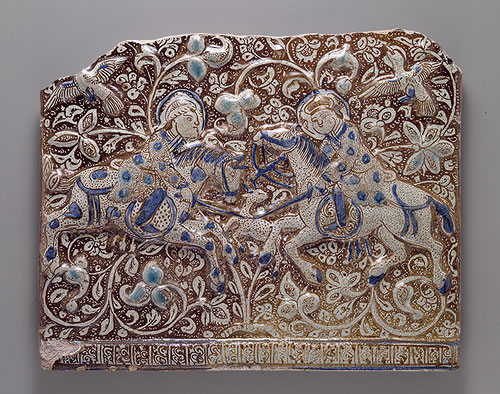 |
| Figure 7 Hunting Scene on Ceramic Tile |
 |
| Figure 8 Hunting Scene in Manuscript |
The dissemination and use of the same patterns amongst different artistic modes of production enabled a visually cohesive representation of the Ilkhanids, which could be recognised by the Islamic population within the current Ilkhanid dynasty as well as future regimes. Moreover, according to Mohammad Khazaie, the ‘….decorative motifs were transferred from the arts of the book particularly Qur'an manuscripts, to other arts. The materials, techniques and functions might differ, but the designs remained the same. This direct connection between the artists of the book and those practicing other decorative arts…has continued until the present day.’[xii] This visual continuum was not solely due to the ideology of l’art pour l’art; instead it was partially indebted to the tastes and ideals involved with patronage.[xiii] Sheila Blair cites Jean Aubin’s insightful research by stating, ‘…much of what is commonly called Ilkhanid architecture or painting was underwritten not by Mongols or their noyan but by native Iranian counsellors who guided the Mongols’ pretensions and inspired their tastes.’[xiv] An example of such a patron was Rashid al-Din, who was the politically powerful and wealthy vizier of the Ilkhanid ruler Uljaytu.
The records of al-Din’s life and accomplishments mirror the stage upon which he and other courtly figures of the Ilkhanid dynasty were not only establishing themselves, but also the reputation of their dynasty based upon the scale of the patronage during the time.[xv] Sheila Blair notes that ‘[t]he model of patronage established by the highest members of the Ilkhanid court in north-western Iran was copied by other notables elsewhere in Iran in this and the following generation.’[xvi] A wealth of patrons, a visual programme and similar artistic models, upon which the decoration of objects, manuscripts and architecture were derived, allowed for a dispersal of a visually amalgamated artistic repertoire that represented the Ilkhanids and their tastes. Furthermore, ‘[a]fter the death of the last Ilkhanid ruler of the united dynasty in 1335, the empire disintegrated and a number of local dynasties came to power in Iraq and Iran, each emulating the style set by the Ilkhanids,’ which supports the aforementioned suggestion that the Islamic artistic style was built upon, and continuously evolved from, artistic genres of the past.[xvii] An example of a successive dynasty, which drew from the ideology of intertwining a visual programme on different art forms, as a reflection of the potency of their regime, was the Timurid dynasty. It was ‘through the creation of a variety of objects—books, decorative works, metalware, woodwork—[that] Timur’s image was further developed and amplified.’[xviii] With the formation of a visually cohesive empire, through the projects of the kitabkhana, Timur was able to dominate the aesthetic vocabulary of his regime, thus creating an association of beauty and strength to the Timurid dynasty, which was partially indebted to the artistic innovations of the Ilkhanids.[xix]
The records of al-Din’s life and accomplishments mirror the stage upon which he and other courtly figures of the Ilkhanid dynasty were not only establishing themselves, but also the reputation of their dynasty based upon the scale of the patronage during the time.[xv] Sheila Blair notes that ‘[t]he model of patronage established by the highest members of the Ilkhanid court in north-western Iran was copied by other notables elsewhere in Iran in this and the following generation.’[xvi] A wealth of patrons, a visual programme and similar artistic models, upon which the decoration of objects, manuscripts and architecture were derived, allowed for a dispersal of a visually amalgamated artistic repertoire that represented the Ilkhanids and their tastes. Furthermore, ‘[a]fter the death of the last Ilkhanid ruler of the united dynasty in 1335, the empire disintegrated and a number of local dynasties came to power in Iraq and Iran, each emulating the style set by the Ilkhanids,’ which supports the aforementioned suggestion that the Islamic artistic style was built upon, and continuously evolved from, artistic genres of the past.[xvii] An example of a successive dynasty, which drew from the ideology of intertwining a visual programme on different art forms, as a reflection of the potency of their regime, was the Timurid dynasty. It was ‘through the creation of a variety of objects—books, decorative works, metalware, woodwork—[that] Timur’s image was further developed and amplified.’[xviii] With the formation of a visually cohesive empire, through the projects of the kitabkhana, Timur was able to dominate the aesthetic vocabulary of his regime, thus creating an association of beauty and strength to the Timurid dynasty, which was partially indebted to the artistic innovations of the Ilkhanids.[xix]
 |
| Figure 9 Illustration of Vegetal Motif |
 |
| Figure 10 Engraved Stone-Vegetal Motif |
The symbolism of Islamic decoration is multivalent. Even though there is not a concrete definition, or manner in which to see the use of ornament, it possesses a cultural meaning that can be identified as Islamic for a certain period of time due to its flexible nature. The length of time to which definitions may be ascribed is not definite, which leaves it open to suggestions of scholars, like me, who may deem the symbolism to be either finite or infinite depending on the context in which the decoration is applied. For this post, one certainty may be claimed amongst this abyss of ambiguity. The use of specific decorative themes throughout the artistic programmes of objects, manuscripts and architecture had socio-political implications, which identified and amalgamated the positions of Islamic regimes.
So what does the creation of a recognisable visual repertoire suggest to contemporary artists and art historians? To me, it is a reminder of the cyclicality of time and how we inevitably will always look to our past in order to justify our own place in the present. We yearn to create a new pathway to timeless recognition, much like the Islamic regimes of the Middle Ages, but only on a smaller scale. Does this make the 21st century reflective of the medieval? Maybe. We are digitalising medieval manuscripts as a means to preserve and share the recorded knowledge during Middle Ages. This technological endeavour not only bridges the past with the present, but also may create more of a need for artists and intellects alike to find a manner in which to outwardly define ourselves, so that the 21st century won’t be forgotten in the dark abyss of time in the far future.
So what does the creation of a recognisable visual repertoire suggest to contemporary artists and art historians? To me, it is a reminder of the cyclicality of time and how we inevitably will always look to our past in order to justify our own place in the present. We yearn to create a new pathway to timeless recognition, much like the Islamic regimes of the Middle Ages, but only on a smaller scale. Does this make the 21st century reflective of the medieval? Maybe. We are digitalising medieval manuscripts as a means to preserve and share the recorded knowledge during Middle Ages. This technological endeavour not only bridges the past with the present, but also may create more of a need for artists and intellects alike to find a manner in which to outwardly define ourselves, so that the 21st century won’t be forgotten in the dark abyss of time in the far future.
~Shandra
[i] The ornamental programme of Islamic art did, and continues to, change stylistically, but the basis of geometric and vegetal ornamentation has generally remained recognisable.
[ii] Oleg Grabar, "Architecture," in The Legacy of Islam, by Joseph Schacht, Clifford Edmund Bosworth, and Thomas Walker Arnold (Oxford: Clarendon Press, 1974), 247.
[iii] Ibid, 247-248
[iv] Ibid, 250-251
[v] Suzan Yalman and Linda Kamaroff, "The Art of the Ilkhanid Period (1256–1353)," Heilbrunn Timeline of Art History. New York: The Metropolitan Museum of Art, 2000–., October 2001, accessed March 28, 2012, http://www.metmuseum.org/toah/hd/ilkh/hd_ilkh.htm.
[vi] Sheila Blair, Jonathan Bloom, and Richard Ettinghausen, "Architecture in Iran and Central Asia under the Ilkhanids and Their Successors," in The Art and Architecture of Islam 1250-1800 (New Haven [Conn.: Yale University Press, 1994), 5.
[vii]Suzan Yalman and Linda Kamaroff, "The Art of the Ilkhanid Period (1256–1353)," Heilbrunn Timeline of Art History. New York: The Metropolitan Museum of Art, 2000–., October 2001, accessed March 28, 2012, http://www.metmuseum.org/toah/hd/ilkh/hd_ilkh.htm.
[viii] Sheila Blair, Jonathan Bloom, and Richard Ettinghausen, "Architecture in Iran and Central Asia under the Ilkhanids and Their Successors," in The Art and Architecture of Islam 1250-1800 (New Haven [Conn.: Yale University Press, 1994), 8.
[ix] Nandini Bagchee, "Book Illumination and Architectural Decoration: The Mausoleum of Uljaytu in Sultaniyya" (thesis, Massachusetts Institute of Technology, 2000), 47, accessed April 2, 2012, http://dspace.mit.edu.
[x] Sheila Blair, "Patterns of Patronage and Production in Ilkhanid Iran: The Case of Rashid Al-Din," in The Court of the Il-Khans: 1290-1340 : [the Barakat Trust Conference on Islamic Art and History, St. John College, Oxford, Saturday, 28 May 1994], by Julian Raby and Teresa Fitzherbert (Oxford: Oxford University Press, 1996), 46.
[xi] Stefano Carboni and Qamar Adamjee, "Takht-i Sulayman and Tile Work in the Ilkhanid Period," Heilbrunn Timeline of Art History. New York: The Metropolitan Museum of Art, 2000–, October 2003, accessed March 28, 2012, http://www.metmuseum.org/toah/hd/khan7/hd_khan7.htm.
[xii] Mohammad Khazaie, "The Qur'an Manuscripts from Early Islamic Iran (10th to MID-13th AD)," The International Journal of Humanities 9, no. 2 (Spring 2002): 45.
[xiii] l’art pour l’art is a term that was originally coined by nineteenth century French philosopher Victor Cousin. It is based upon an ideology that art is made irrespective of politics or social justification.
[xiv] Sheila Blair, "Patterns of Patronage and Production in Ilkhanid Iran: The Case of Rashid Al-Din," in The Court of the Il-Khans: 1290-1340 : [the Barakat Trust Conference on Islamic Art and History, St. John College, Oxford, Saturday, 28 May 1994], by Julian Raby and Teresa Fitzherbert (Oxford: Oxford University Press, 1996), 39.
[xv] Further information about the endowment of Rashid al-Din’s atelier endowment can be found in: D. Fairchild. Ruggles, Islamic Art and Visual Culture: An Anthology of Sources (Malden, MA: Wiley-Blackwell, 2011), 35-38.
[xvi] Sheila Blair, "Patterns of Patronage and Production in Ilkhanid Iran: The Case of Rashid Al-Din," in The Court of the Il-Khans: 1290-1340 : [the Barakat Trust Conference on Islamic Art and History, St. John College, Oxford, Saturday, 28 May 1994], by Julian Raby and Teresa Fitzherbert (Oxford: Oxford University Press, 1996), 54
[xvii] Suzan Yalman and Linda Kamaroff, "The Art of the Ilkhanid Period (1256–1353)," Heilbrunn Timeline of Art History. New York: The Metropolitan Museum of Art, 2000–., October 2001, accessed March 28, 2012, http://www.metmuseum.org/toah/hd/ilkh/hd_ilkh.htm.
[xviii] Thomas W. Lentz, "The Kitabkhana and the Dissemination of the Timurid Vision," in Timur and the Princely Vision: Persian Art and Culture in the Fifteenth Century : [exhibition... Arthur M. Sackler Gallery, Smithsonian Institution, Washington, DC, April 16 - July 6, 1989 ...] (Washington, DC: Smithsonian Institution Pr., 1989), 43.
[xix] Thomas W. Lentz, "The Kitabkhana and the Dissemination of the Timurid Vision," in Timur and the Princely Vision: Persian Art and Culture in the Fifteenth Century : [exhibition... Arthur M. Sackler Gallery, Smithsonian Institution, Washington, DC, April 16 - July 6, 1989 ...] (Washington, DC: Smithsonian Institution Pr., 1989), 159-237; Linda Komaroff and Stefano Carboni, The Legacy of Genghis Khan: Courtly Art and Culture in Western Asia, 1256-1353 (New York: Metropolitan Museum of Art, 2002), 225.
Figures:
[1] http://7junipers.com/log/category/eras/medieval
[2] "Frieze tile with phoenix [Iran] (12.49.4)". In Heilbrunn Timeline of Art History. New York: The Metropolitan Museum of Art, 2000–. http://www.metmuseum.org/toah/works-of-art/12.49.4 (October 2006).
[3] Linda Komaroff and Stefano Carboni, The Legacy of Genghis Khan: Courtly Art and Culture in Western Asia, 1256-1353 (New York: Metropolitan Museum of Art, 2002).
[3] Linda Komaroff and Stefano Carboni, The Legacy of Genghis Khan: Courtly Art and Culture in Western Asia, 1256-1353 (New York: Metropolitan Museum of Art, 2002).
[4] Ibid.
[5] Sheila Blair and Jonathan Bloom, "Oljeitu Tomb," digital image, MIT Libraries, Aga Khan Visual Archive, 1984, accessed April 17, 2012, http://archnet.org.
[6] Colin F. Baker, Qur'an Manuscripts: Calligraphy, Illumination, Design (London: British Library, 2007).
[6] Colin F. Baker, Qur'an Manuscripts: Calligraphy, Illumination, Design (London: British Library, 2007).
[7]"Frieze tile with two hunters [Iran (probably Takht-i Sulayman)] (10.9.1)". In Heilbrunn Timeline of Art History. New York: The Metropolitan Museum of Art, 2000–. http://www.metmuseum.org/toah/works-of-art/10.9.1 (October 2006)
[8] http://www.metmuseum.org/Collections/search-the-collections/140005537
[9] Thomas W. Lentz, "The Kitabkhana and the Dissemination of the Timurid Vision," in Timur and the Princely Vision: Persian Art and Culture in the Fifteenth Century : [exhibition... Arthur M. Sackler Gallery, Smithsonian Institution, Washington, DC, April 16 - July 6, 1989 ...] (Washington, DC: Smithsonian Institution Pr., 1989).
[10] Ibid.


